Art lovers who visit NYC often head straight for the big museums: the Metropolitan, the Museum of Modern Art, Frick, the Guggenheim, etc. etc. But some of the best up and coming art can’t be found in these larger, impressive institutions, not even in the MoMA. Sometimes galleries are the best places to see not only modern and new art but also shows by some of the rarer artists out there, dead or alive.
Because NYC is such a massive place it would be impractical to schlep around the city all day going to heaps of different venues for only about 20-30 minutes at a time. Therefore, certain areas sensitive to the arts have become cultural meccas for high quality and more importantly, free galleries. These include SoHo, Mid-town and of course, Chelsea.
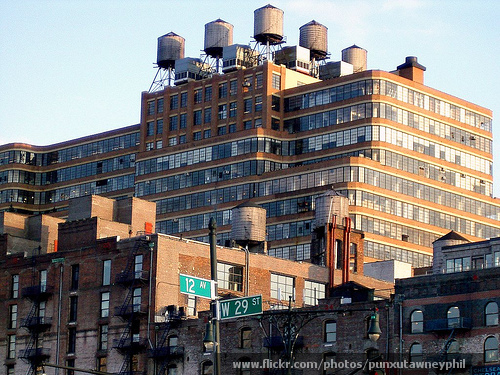
But even within Chelsea itself there are a ton of galleries not only on ground level but up above, as is characteristic of NYC. If you’ve got a full day to spend in this area then by all means my highest recommendation is to literally wander the streets and stairways of Chelsea and see what you stumble upon as this can lead you to the best galleries, the most unknown artists, and sometimes even a poorly advertised opening, which can always be a blast. Some of the best artists after all do tend to be rather unorganized.
But if you haven’t got the time to do it all, which few of us ever do, then here is a brief list of some of the better known venues in the area where you’re bound to see excellent art, probably recognize a few names, and hopefully even discover a few new talents you’ve yet to hear of.
Pace-Wildenstein:
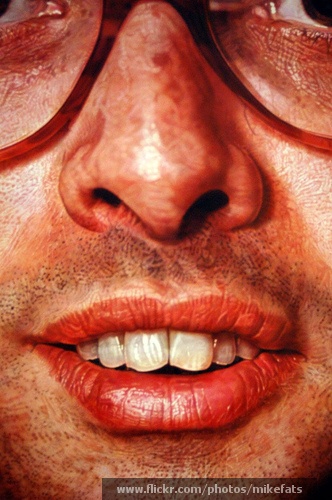
This gallery has two locations in Chelsea and one further uptown. They have supported and made names for hundreds of artists since their start up in Boston in the 1960’s and are truly one of the best galleries in NYC. One of their sites is for much larger works while the other is smaller and accommodates works appropriate to that size. Past exhibits with bigger names have included Chuck Close (image on right), Zhang Huan, Jean Michel Basquiat with Jean Philippe DuBuffet, Pablo Picasso, Willem de Kooning, and Isamu Noguchi.
Locations:
534 W 25th St & 545 W 22nd St (Larger Venue) (near 10th Ave)
New York, NY.
(212) 929-7000 & (212) 989-4285 (respectively)
Hours:
Open Tue-Sat 10:00 am – 6:00 pm
Cheim and Read:
A smaller gallery than some of the bigger named ones, Cheim and Read mainly shows paintings, prints and sculptures of only the highest quality and most fascinating subject matter. In the past they’ve had shows with wonderful works by well-known artists such as Andy Warhol and Louise Fishman. Their sculpture shows are really overwhelmingly beautiful and make them a reliable gallery to turn to for this medium in a city filled with questionable sculptures and public art.
Location:
547 W. 25th St
New York, NY.
(212) 242-7727
Hours:
Tuesday-Thursday 10:00 am – 6:00 pm
Friday 10:00 am – 4:00 pm
Gagosian:
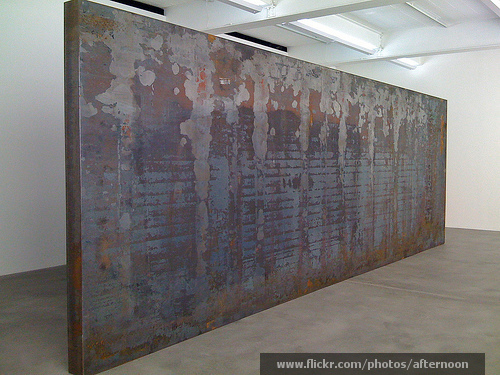
One of the biggest named galleries in NYC, the Gagosian houses some of the more famous gallery work such as selections by Richard Serra (image on right), Cy Twombly, Cindy Sherman, Pablo Picasso, Roy Lichtenstein, Richard Wright, Basquiat, de Kooning, Andy Warhol, and the list goes on.
One of the reasons for the Gagosian’s celebrity status is not only the quality of their selections but the fact that they are, for lack of a better word, a chain. They have eight galleries all over the world, with three in NYC, two in London, one in California, one in Rome, and one in Athens. However, because they are still a gallery, you manage to avoid high admission prices and the crowds that you’d experience at museums.
Locations:
555 W. 24th St and 522 W. 21st St.
New York, NY.
(212) 741-1111 & (212) 741-1717
www.gagosian.com
Hours:
Summer: Mon-Fri 10:00 am – 6:00 pm
Winter: Tue-Sat 10:00 am – 6:00 pm
Hours subject to change seasonally. Call to confirm.
If these three venues don’t fill up your day or satisfy your need for art then simply browse the windows and see what you like! The galleries are purposely located literally right next to one another to encourage and increase traffic. So, don’t be intimidated and feel free to just wander in. And remember, there are usually great galleries to visit on the upper levels of most Chelsea buildings.
Also, be advised that most galleries are closed on Mondays and close for the evening around 5:00 pm, although there are always exceptions.

{ 2 comments }
What is the DSL collection?
The dsl Collection was created in 2005 and focuses on contemporary Chinese art. It is a private collection currently representing 90 of the leading Chinese avant-garde artists, most of whom have a major influence on the development of contemporary art in China today. Even though it focuses on the contemporary production of works of art of all media of a specific culture, the collection is not guided by the search for an ‘otherness’. It admits basic cultural similarities and dispositions and goes beyond the simplistic approach of looking for typical cultural signs and symbols.
The collection is not only significant on a personal level, but also on a larger scale. We start from a museum approach, which means that we are collecting a wide range of media including painting, sculpture, installation, video, and photography. Furthermore, the choice of works is not oriented on the trends of the market. To choose this kind of approach implies making the collection accessible for the public, as well as documenting the featured works.
The major tools to achieve these goals is the use of new technologies, such as the internet and interactive programs and supports, like for example electronic books. These tools provide the means to share the experience of contemporary culture and to make it more accessible and meaningful for a broader public.
How did we become interested in Chinese art?
Art is the mirror of a Society.
When my wife and I came to Shanghai for the first time in 2005, I felt that there was another logic existing here; something that speaks of a very schizophrenic attitude towards economic development. The city embodies a ceaseless pursuit of the “superhuman” that redefines traditional definitions of humanity, sustainability, scale, and speed. Somehow these feelings were very inspiring and we wanted to find art and artists that express the relationships between contemporary art production and society. We are also interested by the Chinese artists who are living outside mainland China, in Taiwan, for instance, and mainly in the Chinese Diaspora in Europe and the United States. These artists have played a decisive role in defining Chinese contemporary art to audience outside China.
One should also not forget that apart from having a 6000 (5,000?) year-old cultural history, China is the biggest cultural space in the world.
How is our collection different than other collections?
We never compare our collection with others because every collection is by nature unique. However, we follow strict personal guide lines in building our collection.
About Collecting, how do you approach it?
“Collecting,” is not “accumulating.” and it is not “investing.” It is acquiring objects that have some relation to each other and putting those objects into the kind of order that reflects the collector’s response to them. Each true collection achieves a personality beyond and apart from the sum of the objects. I feel also that diversity is one of the main strengths of a collection.
What role does the Collector play?
The Collector should not take centre stage himself and should let the art itself be at the centre of the collection. Artists should be given the maximum spotlight. My role, my real power is to make that happened (My role and my aim is to make this happen. Its what the curator Hans Ulrich Obrist calls “the fundamental invisibility.”
What is the the dsl Collection viewpoints?
- A museum approach
At first we looked at Chinese art according to our personal tastes, but we very soon realized that very few people were systematically collecting Chinese contemporary art, either in China or outside — neither institutions, nor individuals had a museum approach and even less so a university museum approach.
And why this kind of approach?
University museums are unlike other museums. They are not intended to have a powerhouse of masterworks on display, though some have their share of these. They are, before all else, teaching instruments intended for students and scholars to use in a hands-on way. As such, they often house objects that are considered of second- and third-tier value at auction but that fill out a deep and detailed account of cultural history. Intellectual adventure is privileged over box-office appeal.
- Education and entertainment
Entertainment and education have quite different intents, but they can be integrated to achieve both aims. Certainly the demand from younger people has shifted strongly to only paying attention if content is truly entertaining. Beyond that, Art is fundamentally about providing experiences. People today seek engaging and powerful experiences.
In such a large country, how do you choose your artists?
We try at the same time to acquire new works from emerging artists and maintaining interest in the works of China’s more established big names. We are always keen to find individuals who are interested to see where the prevailing boundaries lie, either in terms of content, of materials, of disciplines and how they can push these open; I respond most to art that has powerful links to both the times and the context in which it was created.
We think also that chinese contemporary art at the moment is in the process of breaking away from the Western art canon, which has sort of hit a dead end.
What is our focus?
In this New Age, a private collection is also about inspiring people.
Dsl collection would like to become a platform that is accessible to everybody from everywhere. A place where people can have exciting experiences, build their knowledge and actively participate. With the help of curators and critics we try to get the audience engaged and, consequently, move ideas forward and extend interest in Chinese contemporary art. We see the dsl collection as a place that provides experiences with content and also enables participatory experiences–with other people, both visitors and experts.
Consequently, apart from building the collection, dsl is carrying two strategies aimed at increasing and deepening participation and developing education.
Why is the internet platform interesting in our collection?
Having chosen a museum approach, we felt an obligation to make the works available to the public. The challenge of attracting audiences is hardly new.
We have to admit that many brick and mortar museums for the most part are kind of hidden jewels .They do not have great foot traffic and often they are unable to exhibit many of their important works at the same time.
That is why, as for showing the works we have decided upon, to primarily use technology by creating a website: dslcollection.org. Nevertheless, nothing will ever replace a direct contact between the audience and an artwork.
dsl collection has also adopted many of the internet tools to increase the audience. This is done by creating interactive and participatory forms of engagement and altering the traditional relationship between art and its audience. The online technology allows this flexibility. Our daughter Karen is more and more involved in the collection is focussing in particular on social networking tools like Twitter, Facebook and Second Life.
These latest online services are creating new, more interactive and participatory forms of engagement and altering the traditional relationship between art and its audience.
Does the internet platform play a larger role in China than in the West , and why?
The internet is important because It renders possible an ” EVERYBODY, EVERYWHERE, ALL THE TIME” experience!
This choice is even more important in the case of China where you currently have 300 million people connected and 100 million personal blogs.
Will there be a space to eventually view the collection?
We are working on the concept of a nomad collection that could go from China to Europe and the United States. Meanwhile many works are on loan to museums or biennales. We are of the principle that whenever an artist wants to have his work exhibited, it should always be made available. We would like to have the first exhibition of the collection in a museum in the United States
How will the collection evolve?
The collection is limited to a specific number of art works – about 150 pieces – that, as an entity, is open to constant redefinition. Openness, movement and communication are basic qualities we want to promote. Another important point: When we collect a work of art, you are essentially acquiring not just one work of art but a part in the artist’s entire body of work which is known as an oeuvre. It means that if this oeuvre evolves in a direction that is not the good one for us we decease the work.
We shall focus more and more on education by being ever more present in China in particular. In 2010 dsl collection will be in charge of an Art Management course at the Shanghai University.
Why is art important? What inspires us?
Art is a way to make our life better. It is not about inanimate objects, but about connecting to people. Thanks to this collection we discovered a great country with great people and a great culture
Theout
se days it’s frightful
to come across an open ear
an eye which
has vision
I’ve retained about
three hundred canvases
won’t you come have a look
Comments on this entry are closed.